
On July 1, 2026, the new Chapter II-1 of the Occupational Safety and Health Act (OSHA), titled “Prevention of Workplace Bullying,” together with its implementing regulation, the Regulations Governing Workplace Bullying Prevention Measures (the “Regulations”). Below we summarize four key points, along with the concrete steps that micro and startup employers should take.
1. A New Duty to Report Online
Within the statutory time limits, an employer must log the following onto the platform designated by the competent authority: complaints of workplace bullying received, the results of handling those complaints, and the results of any request for reconsideration (an internal appeal against the investigation outcome). This duty applies to every employer, regardless of company size.
2. Duties Scale With Company Size
The new chapter imposes prevention-and-handling duties of varying intensity according to the size of the business, but the following two duties apply to all employers, no matter how many employees they have:
- The employer must take the necessary preventive measures; and
- Upon becoming aware that an employee has suffered workplace bullying, the employer must take measures that are “immediate,” “effective,” and “appropriate.” Larger businesses must additionally establish a complaint channel, adopt bullying-prevention measures and rules governing complaints and disciplinary action, and set up a complaint-handling unit and an investigation team. For example, an employer with 100 or more employees must form an investigation team in which external members make up no less than one-half, and any one gender makes up no less than one-third.
3. A Mediation Mechanism Before Formal Investigation
A formal investigation often consumes time and resources and can place psychological strain on those involved. To address this, the new chapter includes a mediation mechanism: during the investigation period, and at the complainant’s election, a suitable mediator may help the two sides communicate. Mediation does not replace the investigation. It must stop if either the complainant or the respondent is unwilling to continue, or if no consensus is reached within one month—at which point the employer proceeds with the investigation. For a business, mediation offers an option to resolve the dispute before a full investigation begins, but it cannot be used to evade the duty to investigate, nor may either party be forced to accept it.
4. External Intervention When the Respondent Is the Highest-ranking Responsible Person
Where the respondent is the company’s highest-ranking responsible person, an internal investigation inevitably raises concerns about conflicts of interest and institutional failure. To address this, the Ministry of Labor has issued the Regulations Governing the Handling by Local Competent Authorities of Workplace Bullying Complaints Against the Highest-ranking Responsible Person (the “Complaint-Handling Regulations”). Under these rules, the local competent authority receives and investigates complaints in which the respondent is the highest-ranking responsible person, so that external public authority steps in and enhances the objectivity and fairness of handling such cases. Notably, “highest-ranking responsible person” is not limited to the representative recorded in the company registration; it also extends to a “person equivalent in role to the representative.” Such a person must meet two conditions:
- The person substantively performs the representative’s functions or controls the organization’s personnel, finances, or business operations.
- The person holds one of the statuses listed in the Complaint-Handling Regulations—for example, a current or former director or supervisor of the company; a shareholder holding 20% or more of the shares; or a relative of the representative, such as a spouse or former spouse, a blood relative within the fourth degree of kinship, or a relative by marriage such as the spouse of a blood relative within the third degree (for the full scope, see Article 3, subparagraph 2 of those Regulations).
This expanded scope matters most to family businesses. Where family members hold key positions, or where shareholding is concentrated among relatives, the business should carefully review which members fall within the “highest-ranking responsible person” category by virtue of substantively controlling personnel, finances, or business operations; once such a member becomes a respondent, the complaint will be handled by the local competent authority rather than internally.
Official Resources and the Investigator Talent Database
To help businesses comply, the Occupational Safety and Health Administration under the Ministry of Labor has published a guidance manual, FAQs, and educational materials on its website, available for viewing and download. The Ministry has also established a “Professional Investigator Talent Database for Workplace Bullying,” making it easier for businesses to find suitable external investigators. Our firm’s attorneys have completed the relevant training and are listed in this database.
The most common misconception is that micro or startup businesses below a certain headcount are exempt, or need not take any action. In fact, even where the workforce is under 10, the employer still has a duty to take preventive measures and to take immediate, effective, and appropriate measures. Doing nothing at all is very likely to breach these two duties.
Micro and Startup Businesses Must Comply Too
For micro and startup businesses, we recommend the following three actions:
- Have your HR and legal teams complete at least three hours of training as soon as possible to qualify as internal investigation committee members. If a complaint later arises within the company, HR or legal can then serve as internal investigators. The Ministry of Labor offers free e-learning courses that are well worth using.
- For managers at all levels, HR can begin with internal training using the OSHA Administration’s YouTube videos (no logged training hours required). HR may consider using tools such as AI to design quiz questions or worksheets, have each trained manager complete them afterward and record the date, and—per Article 26 of the Regulations—retain the training records for three years.
- Set up automated refresher reminders: have HR and legal teams schedule recurring calendar reminders (for example, a refresher every six months), notify HR and managers together, and keep the corresponding records of completion. For guidance on how the e-learning resources are organized, see the official page.
Rather than being caught off guard when the first complaint lands, it is better to put the systems and personnel training in place while the new rules are just taking effect. If you have any questions about workplace bullying prevention, investigation, or handling, please feel free to contact us at any time.
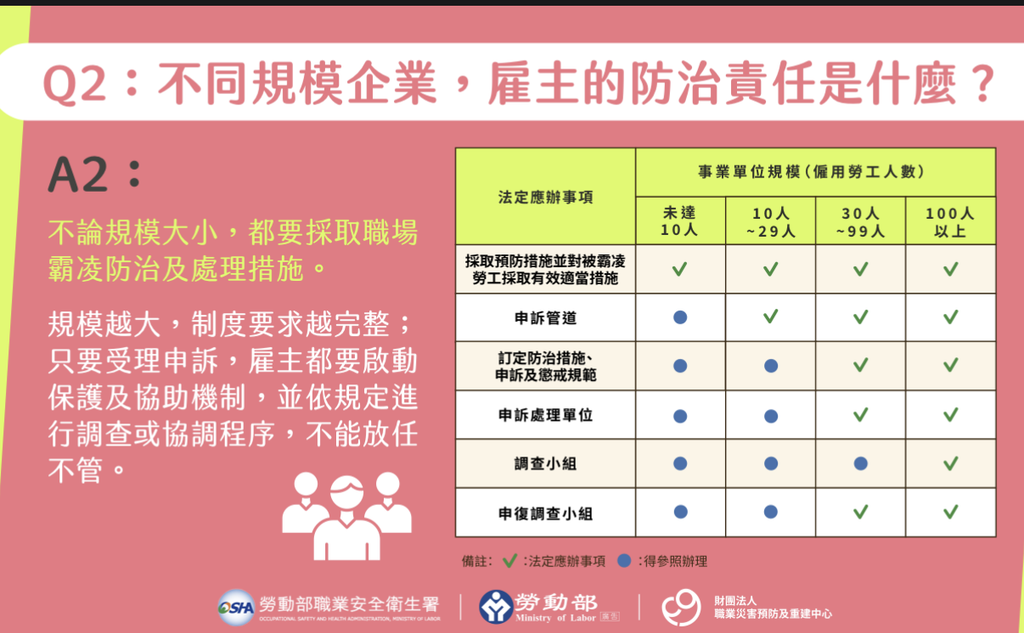
(Source: Workplace Bullying Prevention: Q&A at a Glance, by Occupational Safety and Health Administration, Ministry of Labor)